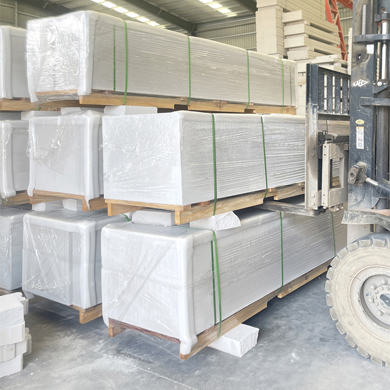
Battery Energy Storage Systems (BESS) are one of the fastest-growing segments of the renewable energy industry, but they also present unique fire safety challenges that demand specialized wall solutions — and ALC wall panels have emerged as a leading choice to mitigate thermal runaway risks.
When a lithium-ion battery enters thermal runaway, it can release temperatures exceeding 1000°C and flammable gas in a matter of seconds. Standard wall materials often fail quickly under this extreme heat, allowing the fire to spread to adjacent battery racks and trigger a cascading failure across the entire facility. 200mm ALC wall panels, however, maintain full structural integrity for over 4 hours even under these ultra-high temperatures, creating solid, non-combustible separation barriers between different BESS zones.
Unlike metal partition walls that rapidly conduct heat and accelerate thermal transfer between racks, ALC panels’ low thermal conductivity keeps the unexposed side of the wall at safe temperatures for hours. This prevents the heat from an ignited battery compartment from triggering thermal runaway in neighboring battery units, buying critical time for on-site fire suppression systems to activate and for emergency teams to respond.
Many global renewable energy developers now specify ALC wall panels as a core part of their BESS fire design strategy, aligning with updated safety guidelines for large-scale energy storage facilities. These panels not only meet strict local fire codes but also reduce the overall fire insurance premium for BESS sites, making them a cost-effective long-term investment for renewable energy projects.


