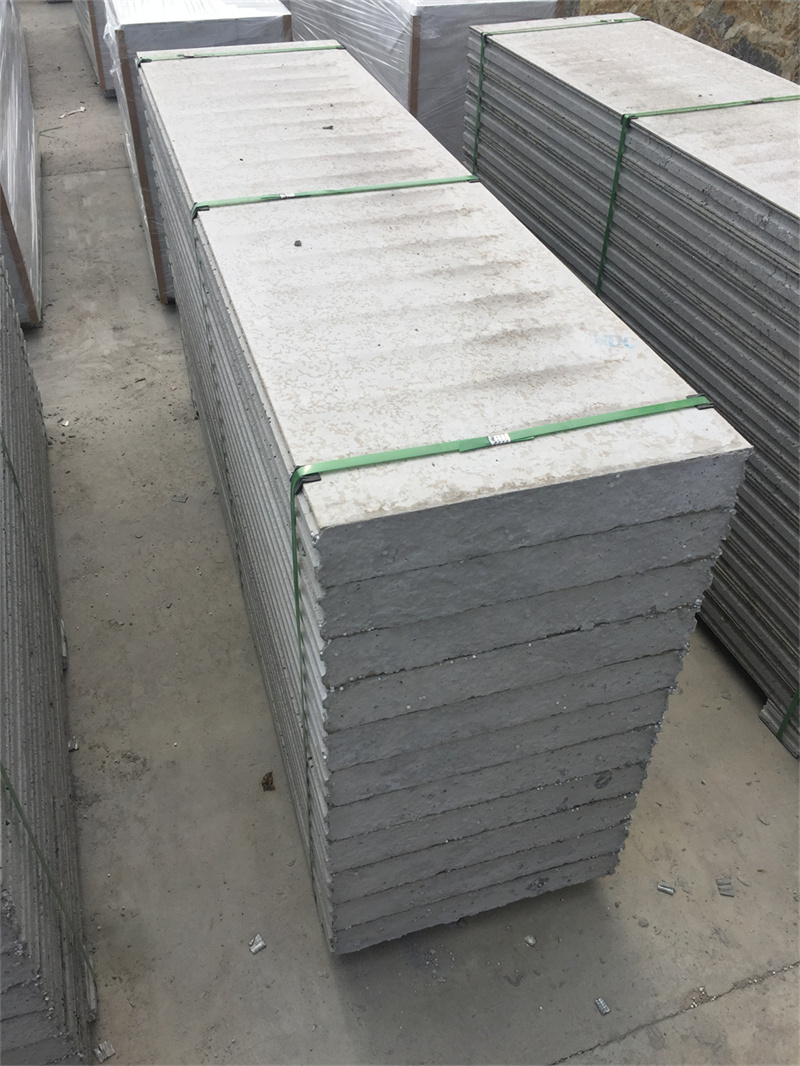
What Is EPS Cement Sandwich Panel?An
EPS cement sandwich panel (also known as EPS sandwich wall panel, EPS lightweight wall panel, or simply EPS wall panel) is a composite building material made of three layers bonded together — much like a sandwich:
-
Two outer layers of fiber-reinforced calcium silicate board or cement board
-
A core layer of expanded polystyrene (EPS) foam beads mixed with cement, sand, and additives
This unique sandwich structure gives the panel an exceptional combination of properties that no single material can achieve alone:
lightweight yet strong, insulated yet fireproof, thin yet soundproof.Originally developed in Europe and refined in China over the past two decades, EPS cement sandwich panels have become one of the most widely used prefabricated wall materials in Asia, the Middle East, Africa, and increasingly in Europe and the Americas. They are certified under international building standards including ISO, CE, and SGS.
Quick Fact: A standard EPS cement sandwich panel weighs only 1/6 to 1/8 of an equivalent brick wall — yet provides comparable or better structural, thermal, and acoustic performance.
Panel Structure & Composition Outer Facing LayersThe two facing boards are typically made from calcium silicate board or fiber-reinforced cement board, both of which are:
- Non-combustible (Class A1 fire rating)
- Water-resistant and moisture-proof
- High in flexural and impact strength
- Smooth-surfaced for direct painting or finishing
Standard facing thickness: 5mm per side (customizable to 4mm–8mm).
Core LayerThe core is a composite of:
- Expanded Polystyrene (EPS) beads — lightweight, excellent thermal insulator (density: 10–20 kg/m³)
- Portland cement — provides structural bonding and compressive strength
- Fine sand — enhances density and mechanical properties
- Chemical additives — improve water resistance, setting time, and workability
The EPS beads replace the majority of aggregate found in traditional concrete, creating a lightweight yet structurally sound core. The cement binder holds everything together while the EPS beads trap air pockets, giving the core its insulating properties.
Panel Edge DesignHanmero panels feature a tongue-and-groove edge system: one side has a protruding tongue, the opposite side has a matching groove. When installed, the interlocking edges create tight, seamless joints that minimize thermal bridging and sound leakage.
Technical Specifications Standard Dimensions| Parameter | Specification |
| Length | 2,440 mm / 3,000 mm (customizable up to 4,000 mm) |
| Width | 610 mm (standard) |
| Thickness | 75 mm / 100 mm / 120 mm / 150 mm / 200 mm |
Performance Data by Thickness| Thickness | Weight (kg/m²) | Thermal Conductivity (W/m·K) | Sound Insulation (dB) | Fire Rating |
| 75 mm | 45–50 | 0.085 | 38 | A1 (Non-combustible) |
| 100 mm | 55–60 | 0.072 | 42 | A1 (Non-combustible) |
| 120 mm | 65–70 | 0.062 | 45 | A1 (Non-combustible) |
| 150 mm | 75–80 | 0.052 | 48 | A1 (Non-combustible) |
| 200 mm | 95–100 | 0.042 | 52 | A1 (Non-combustible) |
Core Mechanical Properties| Property | Value | Standard |
| Compressive Strength | ≥ 3.5 MPa | GB/T 23451 |
| Bending Strength | ≥ 0.8 MPa | GB/T 23451 |
| Impact Resistance | ≥ 5 times (30kg sandbag) | GB/T 23451 |
| Hanging Force | ≥ 1,000 N (single point) | GB/T 23451 |
| Water Absorption | ≤ 8% | GB/T 23451 |
| Drying Shrinkage | ≤ 0.6 mm/m | GB/T 23451 |
7 Key Advantages of EPS Cement Sandwich Panels ① Lightweight — Reduce Structural Load by Up to 80%At just 45–100 kg/m², EPS cement sandwich panels are dramatically lighter than traditional brick walls (350–500 kg/m² for a 240mm brick wall). This means:- Smaller foundations — less concrete and steel required
- Lower transportation costs — more panels per truck load
- Easier handling — no heavy lifting equipment needed on site
- Reduced seismic risk — lighter structures are safer in earthquake zones
② Fireproof — Class A1 Non-CombustibleBoth the calcium silicate facing boards and the cement-bonded core are non-combustible. The panels achieve a Class A1 fire rating under GB8624 (equivalent to the highest European fire classification). Even under direct flame exposure for 4+ hours, the panel maintains structural integrity and does not produce toxic gases. Fire Safety Note: Unlike some EPS-only panels (which can be fire hazards), the EPS beads in cement sandwich panels are fully encapsulated within the cement matrix. Even if exposed to extreme heat, the cement shell prevents the EPS from igniting.
③ Waterproof — Suitable for Bathrooms, Kitchens & Exterior WallsThe cement-based facing layers are inherently water-resistant, and the core's water absorption rate is ≤8%. Hanmero panels have been tested in high-humidity environments and maintain structural integrity even after prolonged water exposure. This makes them ideal for:- Bathroom and kitchen partition walls
- Exterior wall applications
- Basement and underground structures
- Coastal and tropical climate buildings
④ Sound Insulation — 38–52 dB Noise ReductionThe multi-layer sandwich structure is extremely effective at blocking sound transmission. Depending on thickness, panels achieve 38–52 dB sound insulation:- 75mm panel (38 dB) — general office partitions
- 100mm panel (42 dB) — residential buildings
- 150mm panel (48 dB) — hotel and hospital grade
- 200mm panel (52 dB) — recording studio / high-privacy
For comparison, a standard 240mm brick wall achieves approximately 45–48 dB. A 150mm EPS panel matches or exceeds this at less than 1/4 the weight.
⑤ Thermal Insulation — Cut Energy Bills by 30–50%With thermal conductivity as low as 0.042 W/m·K (for 200mm panels), EPS cement sandwich panels provide insulation comparable to dedicated insulation layers:- A 100mm EPS panel is equivalent to a 600mm brick wall in thermal performance
- A 150mm panel matches a 900mm brick wall
- Building heating and cooling costs can be reduced by 30–50%
This is particularly valuable in regions with extreme climates — the Middle East, Central Asia, Northern Europe, and high-altitude areas.
⑥ Fast Installation — 10× Faster Than Brick LayingA trained 3-person team can install 50–80 m² of EPS panels per day, compared to only 5–8 m² of brick wall:- Panels arrive ready to install — no curing or drying time
- Tongue-and-groove system ensures precise alignment
- No wet mortar between courses (only at joints and base)
- Panels can be cut on-site with standard tools
- Immediate surface finishing — no plastering needed
⑦ Eco-Friendly — Green Building CertifiedEPS cement sandwich panels contribute to green building certifications (LEED, BREEAM, Green Star):- Lower embodied energy — less cement and steel per m² of wall
- Reduced construction waste — precise factory dimensions, minimal on-site cutting
- Energy efficiency — reduces building operational carbon footprint
- Recyclable EPS — polystyrene beads can be sourced from recycled material
- No harmful emissions — zero formaldehyde, zero asbestos, zero radioactive substances
Common Applications Interior Partition WallsThe 1 application worldwide. 75mm and 100mm panels are widely used for:
- Office and commercial space subdivisions
- Hotel room partitions
- Apartment interior walls
- Hospital ward partitions
- School classroom dividers
Exterior Walls120mm–200mm panels serve as load-bearing or non-load-bearing exterior walls for:
- Residential buildings (villas, apartments, townhouses)
- Commercial structures (shops, offices, warehouses)
- Industrial facilities
- Cold storage and temperature-controlled buildings
Prefabricated & Modular Buildings- Portable site offices and labor camps
- Modular housing units
- Disaster relief shelters
- Temporary and semi-permanent structures
Renovation & Additions- No structural reinforcement needed for the existing building
- Fast completion — minimize disruption
- No heavy equipment required on upper floors
EPS Panel vs. Traditional Brick Wall: Head-to-Head| Property | Traditional Brick Wall (240mm) | EPS Sandwich Panel (100mm) |
| Weight | ~450 kg/m² | ~58 kg/m² (87% lighter) |
| Thickness | 240mm (+ plaster) | 100mm (60% thinner) |
| Fire Rating | A1 | A1 (same) |
| Sound Insulation | 45–48 dB | 42 dB (comparable) |
| Thermal Conductivity | 0.81 W/m·K | 0.072 W/m·K (11× better) |
| Installation Speed | 5–8 m²/day/team | 50–80 m²/day/team |
| Construction Type | Wet construction | Dry — fast & clean |
| Foundation Requirement | Heavy | Standard sufficient |
Cost Impact: While the per-square-meter material cost of EPS panels may be comparable to brick, the total installed cost is typically 15–30% lower when you factor in reduced labor, faster completion, smaller foundations, and eliminated plastering.
Installation Overview Step 1: Floor & Ceiling Preparation
Mark panel layout lines on the floor and ceiling using a chalk line. Install U-shaped steel tracks (or timber battens) along the lines as guides.
Step 2: Panel Placement
Apply cement mortar or special adhesive along the bottom track and one vertical edge. Stand the first panel upright, tongue side facing the direction of installation. Press firmly into position and check plumb with a spirit level.
Step 3: Joint Treatment
Slide the next panel's groove onto the previous panel's tongue. Ensure tight joints with no gaps. Apply mortar between panels as needed. Continue along the wall line.
Step 4: Fixing
Secure panels to the structure using steel angles, dowels, or shot-fired pins at top and bottom. Corner panels and end panels require additional fixing.
Step 5: Finishing
Apply fiber mesh tape over all joints. Apply a thin skim coat of joint compound. Once dry, the surface is ready for paint, wallpaper, tiles, or any standard wall finish.
Tools Required: Standard construction tools suffice — circular saw or hand saw, spirit level, rubber mallet, trowel, drill. No specialized equipment needed.
Why Choose Hanmero as Your EPS Panel Supplier- 16+ Years of Manufacturing Experience — Established in 2009, specializing in EPS wall panels
- Exported to 90+ Countries — Asia, Middle East, Africa, Europe, Americas
- ISO 9001:2015 Certified — Rigorous quality control from raw materials to final product
- Full Certification Suite — CE, ISO 14001, SGS testing reports
- Factory-Direct Pricing — No middleman markup
- Custom Specifications — Non-standard thickness/length available, MOQ from 100 m²
- Technical Support — Free installation guides and on-site supervisor service
- Free Samples — Test quality yourself before committing
FAQQ: What is EPS cement sandwich panel?
A: An EPS cement sandwich panel is a lightweight composite building panel consisting of two outer layers of fiber-reinforced cement board and a core of expanded polystyrene (EPS) foam beads mixed with cement. It combines structural strength, thermal insulation, fire resistance, and waterproofing in a single product.
Q: How thick are EPS cement sandwich panels?
A: Common thicknesses include 75mm, 100mm, 120mm, 150mm, and 200mm. 75mm and 100mm for interior partitions; 120mm–200mm for exterior walls and high-performance applications.
Q: Are EPS cement sandwich panels fireproof?
A: Yes. They achieve Class A1 fire rating (non-combustible). The cement-based facings do not burn, and the EPS core is self-extinguishing and fully enclosed within cement.
Q: How much does an EPS cement sandwich panel weigh?
A: 45–50 kg/m² (75mm), 55–60 kg/m² (100mm), 75–80 kg/m² (150mm) — roughly 1/6 to 1/8 of an equivalent brick wall.
Q: Can EPS sandwich panels be used for exterior walls?
A: Absolutely. They are fully waterproof and suitable for exterior applications. Panels of 120mm+ are recommended for exterior use.
Q: How long do EPS cement sandwich panels last?
A: 50+ years when properly installed and maintained.
Q: What is the difference between EPS panel and AAC panel?
A: EPS sandwich panels are lighter, better insulating, easier to cut and install, and more waterproof. AAC panels have higher compressive strength but are heavier and more brittle.
Q: How do you install EPS cement sandwich panels?
A: Mark layout → apply mortar → stand panel upright → secure with steel angles → fill joints → apply tape and skim coat. A 3-person team installs 50–80 m² per day.